ENRICO CARUSO
Italian, 1873-1921
"Laughing Buddha, a Self Portrait" (1909)
Sand-cast patinated bronze executed early 20th century by Roman Bronze Works (cold-stamped verso)
Signed in shoulder in the cast (no cold-tooling) "Enrico Caruso 1909"
5 3/4" H x 3 3/4" D x 3 1/2" W
Provenance:
Sotheby's, New York, 29 October 2002, lot 254, achieved $ 4182 USD
Thereafter the Gilgore Collection, Naples, Florida
ref. 601OZB23P
This bronze bust represents the celebrated operatic tenor Enrico Caruso portraying himself in the guise of a laughing Buddha. The figure is modeled with exaggerated features and a broad, open expression of laughter, his shoulders emerging from a simplified geometric base.
Caruso achieved international prominence in the early twentieth century and became one of the first recording superstars of the gramophone era. Although he performed widely across Europe and the United States, including hundreds of appearances at the Metropolitan Opera in New York, his commercial recordings introduced his voice to an unprecedented mass audience. His 1902 recording of the aria Vesti la giubba from Ruggero Leoncavallo’s opera Pagliacci became the first record to sell more than one million copies.
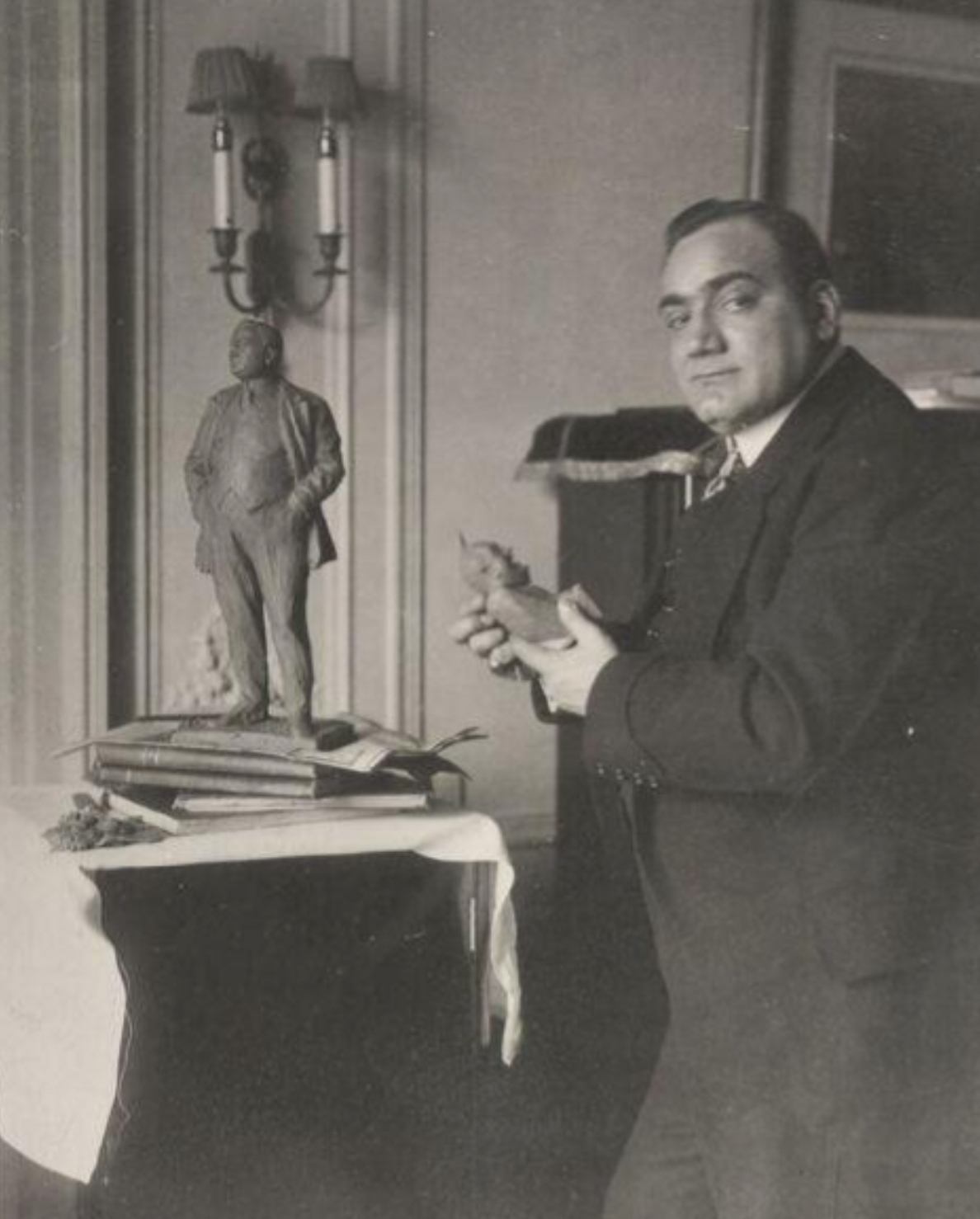
Beyond his musical career, Caruso was an accomplished draftsman and caricaturist. His sketches were regularly published in the Italian American satirical newspaper La Follia di New York and a collection of his drawings appeared in book form in 1908. The present sculpture was believed to have been made by Caruso for his friend and prominent conductor Arturo Toscanini in 1909. It has been suggested that a very small number of casts were produced from the model, though we have not been able to independently confirm this. An example of this work in identical dimensions and patination also cast by the Roman Bronze Works foundry of New York is preserved in the collection of the Victoria and Albert Museum in London along with a photograph (see images) of Caruso holding the model in his hands.
The present cast was sand-cast in one piece and showcases a fabulous nuanced translucent medium-brown patination. The signature is captured in the underlying mold and transferred to the bronze, not tooled into the shoulder, and likely represents a very early cast of the model. The reverse is cold-stamped by Roman Bronze Works. A very fine example.
Condition: Minor wear. Overall very fine state of preservation. Cleaned and carefully waxed. Ready to place.